

Oct 14, 2026
Waterfall Island Countertops: Cost, Best Stones and DFW Projects
By Kris Lamberth, Stone Specialist at USA Granite
If there's one feature homeowners keep asking us for, it's the waterfall island. Designers call it one of the most requested features in new kitchen layouts, and it's easy to see why: the stone flows off the countertop and straight down the side to the floor, so the island looks like one solid block of stone.
It's also a feature where details matter, from how the corner is cut to how the veining lines up. Here's what a waterfall island is, what drives the cost, which stones suit it, and a look at some of our own DFW projects.
What is a waterfall island?
On a standard island, the countertop ends at an edge. On a waterfall island, the stone continues down one or both ends, to the floor. Those vertical pieces are called waterfall panels or legs.
The panels are usually cut from the same slab as the top. The corner where they meet is cut at an angle and joined, a miter, so the pattern can appear to run over the edge in a single piece. You can do a waterfall on one end, both ends, or even wrap an L-shaped island, as in some of the projects below. The same idea works for a bar, a peninsula or a vanity.
What drives the cost of a waterfall island
Every kitchen is different, so we price waterfalls after we measure. We don't publish a number here, because the price depends on a handful of things you can see for yourself:
More stone. Each panel adds square footage. A waterfall on both ends of an island needs noticeably more material than the top alone. If you buy through SlabSmart, you pay for the stone by the square foot, so those extra panels count.
The stone you choose. Stones vary widely in price, and a rare or in-demand slab costs more than a common one. Natural quartzite, granite, quartz and dolomite are all priced differently.
Fabrication time. Mitering the corners, polishing the edges and matching the veining takes skilled hands and time. That's labor you don't need on a flat-edged island.
Slab size and layout. An island has to be cut so the pattern flows. A big island may need more than one slab, and planning where each seam falls is part of the cost.
Support and installation. Stone panels are heavy. The cabinets need to be ready, and installation takes more people and more care than a standard top.
Extras. Sink and cooktop cutouts, edge profiles and a matching backsplash all add up.
The best way to get a real number is a free measure and quote. For general budgeting, read countertop costs in Dallas: what to expect and how to save.
Vein matching and seams: where the craft shows
The question we hear most is "will the pattern line up?" With a good fabricator, it should. Before cutting, we lay out the slab and decide where the island top, the side panels and any seams will fall, so the veining carries around the corner the way you'd expect.
The pattern matters too. A bold veined stone, such as a Calacatta look, shows every line, so it takes more planning. A busy, mottled stone is more forgiving, because the pattern hides the joint. Neither is better; they just have different looks and different demands.
4 stones that suit a waterfall island
All four of these are in our SlabSmart program, in stock at our Dallas slab yard and sold by the square foot.
1. Taj Mahal Quartz: the soft, quiet one
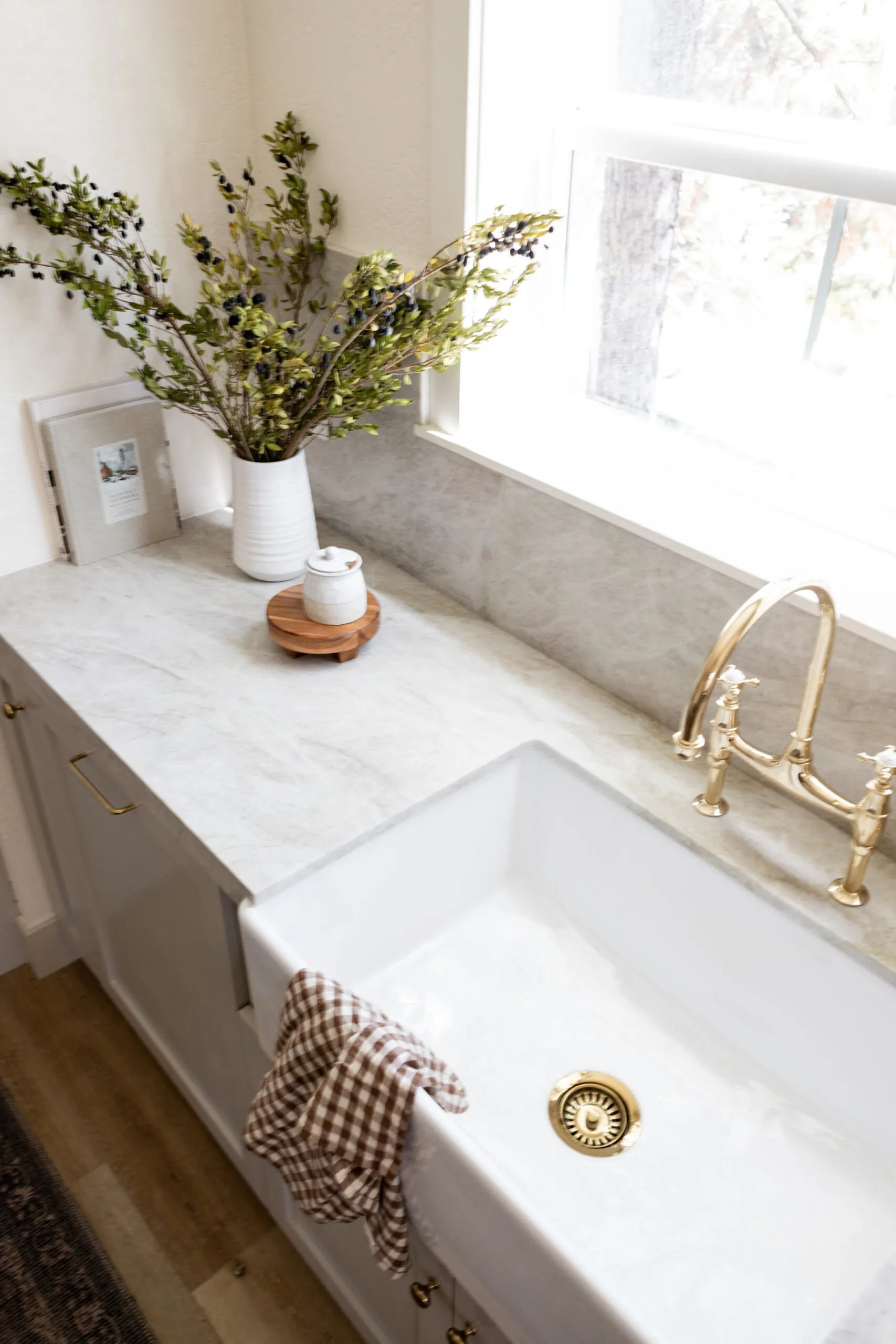
Taj Mahal Quartz in a styled kitchen.
Taj Mahal quartz offers the creamy warmth of the popular Taj Mahal quartzite, with soft veining and neutral tones. Because the pattern is gentle, the waterfall corner is easy on the eye, and it's non-porous, so there's no sealing. Read the full comparison in Taj Mahal quartzite vs. Taj Mahal quartz.
Best for: warm, calm kitchens and busy households.
2. Calacatta Gold Quartz: the showpiece

A Calacatta Gold waterfall island we fabricated in Dallas.
Bold, flowing veins of soft gray and gold on a crisp white background make this one of our most popular choices for statement islands, and it looks dramatic when the veins run down the waterfall panel. It's engineered quartz, so there's no sealing. See our guide to white quartz with gold veins.
Best for: a statement island with brass or gold hardware.
3. Madre Perla Quartzite: natural and pearly
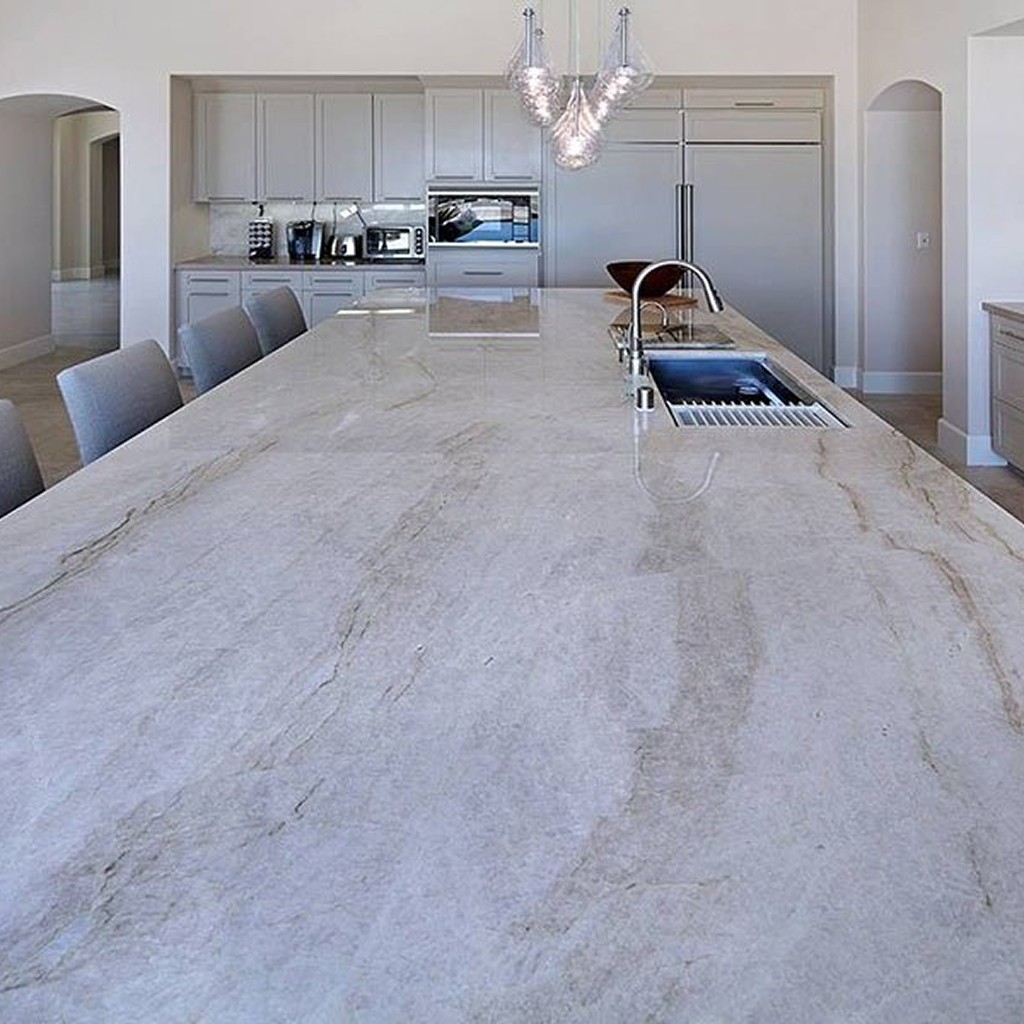
Madre Perla Quartzite in a styled kitchen.
Madre Perla is a natural quartzite in warm beige and soft cream, with subtle pearly movement. It's durable and heat resistant, and the pearly movement looks great flowing over a waterfall edge. Like all natural quartzite, it should be sealed periodically.
Best for: big islands where you want natural stone with a soft glow.
4. Black Forest Granite: the dramatic dark option

Black Forest Granite in a styled kitchen.
Black Forest is a natural granite with a deep black background and bold white veining. It comes in a dual finish: polished for full contrast and glossy depth, or leathered for a softer, matte texture. A dark waterfall island looks striking against white or light cabinets. For more dark ideas, see black countertops for a kitchen island.
Best for: a bold, modern island that anchors the kitchen.
Waterfall islands from DFW projects
We've fabricated waterfall islands in stones from soft whites to bold veins across Dallas–Fort Worth. A few of our projects:

A Taj Mahal waterfall countertop in Carrollton. See the project.

A Fantasy Brown waterfall in North Richland Hills (Fantasy Brown is a dolomite). See the project.
You can also browse our Taj Mahal waterfall with matching backsplash in DeSoto, our Calacatta Gray double waterfall in Dallas and the Calacatta Black waterfall island in Carrollton in the project showcase.
Planning a waterfall island in a DFW home
Open floor plans are common in newer Dallas–Fort Worth homes, and the island is usually the focal point, so a waterfall end that faces the living room makes a big impression. A few tips: check that your cabinet maker knows the finished thickness of the stone, think about where the panel will meet your flooring, and choose one that you'll still love in ten years. If you're also choosing between stone types, read Quartzite vs. Quartz.
Frequently asked questions
How much does a waterfall island cost? It depends on the stone, the size of the island, how many waterfall panels you want and the fabrication involved. We quote after a measure, and the free in-home estimate is the quickest way to get a real number.
Does the veining really line up? It should. We plan the layout on the slab before cutting so the pattern flows around the corner. Bold veined stones take more planning than busy, mottled ones.
Which stone is best for a waterfall island? There isn't one best stone. Quartz is easiest to care for, quartzite and granite are natural and durable, and a quiet pattern is more forgiving than a bold one. Pick the look you love first, then we'll plan the layout.
Can I do a waterfall with a stone that isn't in stock? Yes. We source full slabs from partner suppliers and fabricate and install them for you.
Do I need a waterfall on both sides? No. One end, both ends or a wrap-around are all common. It's mostly a design choice and affects how much stone you need.
Let's plan your island
Come see the slabs in person at our slab yard, 2407 N Walton Walker Blvd in Dallas, or call (214) 927-2571. We fabricate and install across Dallas–Fort Worth.
Prefer we come to you? Book a free in-home estimate.